Monday, June 22, 2020

Horses and Ponies from the Celtic Regions: The Highland Pony


The Highland Pony is one of Scotland's oldest and most common breeds. They were molded by the harsh terrain to become these stable, surefooted ponies. They are used for riding, pack, and farm work. The Highland Pony Society was founded in 1923.
The height ranges from 12.1hh-14.2hh. Their colors consist of the Dun gene and the Grey gene, though the self colors, Black and Brown, do exist.

References:
"International Encyclopedia of Horse Breeds" by Bonnie Hendricks

Sunday, June 21, 2020

Horses and Ponies from the Celtic Regions: The Clydesdale


The Clydesdale, slightly smaller, more elegant, and less feather than that of a Shire, is a true native of Lanarkshire, Scotland (the old name of Lanarkshire is Clydesdale). Surprisingly, the actual breed isn't very ancient. The ancestor, the Flemish Great Horse, was imported during eighteenth century as war horses and for farm work. Eventually, the Flemish Great Horse mixed with local horses to create the Clydesdale - which became the official name in 1826. The Clydesdale Horse Society was founded in 1877. The breed suffered a decline when the tractor took over the farm work. But, they regained popularity with the promotion of the Budweiser beer company.
The height ranges from 16.1hh-18hh. The colors include Bay, Black, Grey, and Sabino. The example above displays the Sabino1 gene, which is a simple, lacy-edged pattern of white extending up from the underside with a characteristic white face. Polygenic Sabinos display a more roany effect that covers the entire body. Clydesdale breeders calls this pattern "Roan," but keep in mind that this is not the same color as the genetic True Roan (Rn).
Breyerfest's 2020 Store Special Benelli displays the typical pattern combination of Grey plus Sabino1.

References:
"International Encyclopedia of Horse Breeds" by Bonnie Hendricks

Saturday, June 20, 2020

ROOAARRRR!!!!! PHOTO SHOWS FOR DINOS!!!!!!

Yes, there are Photo Shows that have classes for Dinosaurs, as well as other animals - real or mythical. Come to find out, MEPSA has a once a year special for all the non-horsie plastic animals. Of course, I was thinking of passing on the opportunity of doing something with all my plastic animals that are just sitting around doing nothing and not being played with. But then I thought, why not? It was fun getting them all out and picking out who's in the greatest condition to show. As it is, a vast majority of these guys I've had since I was a little girl. 

These are from two photo shoots, one at home (the little guys that need my mom's Macro Lens) and one while camping last weekend (the big guys - it was really weird not bringing any horsies!). Here are some of my favorites.

 This one came with a paleontologist Barbie outfit.
 I have three (or four?) of this same mold and they all are slightly different from each other in the same uniform green.
 This is Petrie from The Land Before Time.
 I have two of these guys.
 This long-neck came with the orange Stegosaurus at the top.
 I have three of him - all different shades of green.
 I have no idea where or when I got him. He's apart of my oldest collection. Anybody knows what the JP logo is on his flank?
 I entered this guy even though he has a LOT of play scuffs and rubs.
 This girl is apart of the most recent collection. I had never seen one like her.
 He's my newest guy. He's a Breyer Collecta and I thought they did a great job portraying a different pose other than just standing there. Got him for Christmas last year.
 This is Little Foot from The Land Before Time. That is, I think he's Little Foot. I think I might have two Little Foots....???
 Here's Spike, also from The Land Before Time....You could probably tell what one of my favorite series was when I was a kid.
 I think this guy came from my brother's Mega Bloks Dragons set. I really liked his coloring in comparison to the other dragons available in the sets.
 This girl was a pain to photograph! Her head is just too far away from her body to come in-focus. This was the best I got!
This guy's one of the big ones.
She is too. It was weird getting them out. They felt almost small. But then, I was smaller then.
Talk about nearly blinding yourself while trying to get a flying photo!

 This is Aladar or Alidar - can't remember how to spell his name, both look foreign to me. Anyways, he's an Iguanadon and he's from Disney's "Dinousaur." I loved that movie!
And Sally, I think it was Sally...? Obviously I didn't drill myself on my plastic animal names as often as I did my Breyers.

Horses and Ponies from the Celtic Regions: The Connemara Pony


Connemara Ponies hail from the Connemara Mountains in western County Galway, Ireland. The breed was strictly Celtic, until the Spanish Armada shipwrecked on Ireland's shores - introducing Spanish blood into the breed. They are used for every kind of riding discipline, notably for children. They are bred in Ireland, America, Australia, and in various countries in Europe.
The height ranges from 13-14.2hh. The colors include Bay, Black, Chestnut, Dun (a once predominant color), Roan, Grey, and Brown. These hardy ponies were shaped by their environment.

Breyerfest's 2020 Three-day Ticket SR W.H. Topgun and Single Ticket Arran are classic examples of the Connemara Pony because the breed also exibits the Sooty Gene, a modifier gene that involves brown hairs extending from the top line down over the body. This could range from minimal to the entire horse (these ones need genetic testing to find the true base color). Dappling is very common with this gene.

References:
https://equusmagazine.com/horse-care/connemara
"International Encyclopedia of Horse Breeds" by Bonnie Hendricks

Friday, June 19, 2020

Horses and Ponies from the Celtic Regions: The Kerry Bog Pony

I was originally going to post this series in one big post, but I realized that it would be easier for me to do it in pieces. And now that Breyerfest is on the count down, I figured I better get this Breed Studies series finished.

One thing to keep in mind about me is that I LOVE anything having to do with the Celts. From culture to music to art and now horses. And there are some key characteristics in these Celtic pony descendants that I want you to keep an eye out for.


The Kerry Bog Pony originates from County Kerry (hence the name), Ireland. They were used for light draft work and as pack animals - especially since their surefootedness when navigating the bogs. It is believed they are decedents of the extinct Hobby Horse. Their numbers dropped when they were used by the English as pack animals in the Peninsular War. After the Great Famine (the Potato Famine) and the switch to the Tractor, their numbers decreased so far that there were only twenty individuals in 1994. To prevent extinction, a man by the name of John Mulvihill from Glenbeih, Co. Kerry, who started a breeding program to save and promote the breed. The stud, Flashy Fox became the leading sire to well over 100 foals. The first Kerry Bog Ponies were imported to the U.S. was in 2002.
The height ranges from 10-12hh. They come in the colors: Bay, Brown, Black, Chestnut, Grey, Dun, and Palomino. Interestingly, the registry in Ireland doesn't accept Tobiano (which does occur in the breed), only minimal white markings. The registry in America, however, does (so, the photo above is an example of an American-bred). The body structure is similar to the Morgan Horse, with a dished face similar to the Arabian.

Breyerfest's 2020 Three-day Ticket SR Brighid and Beltane could pass for an American-bred Kerry Bog Pony, while being on the new Welsh Pony molds. I was already aware that Tobiano doesn't occur in any of the Welsh pony/cob breeds, so I knew they had to be Kerry Bog Ponies. After some research, surprisingly, the larger Kerry Bog Ponies are the same height of the smaller Welsh Mountain Ponies. But, Welsh Ponies can reach the height of an Icelandic Horse. So, I asked through a FB group if anyone had both the Breyer Icelandic and the Breyer Welsh Pony Mare to do a comparison. And Lo Behold! The Breyer Welsh Pony Mare is indeed smaller than the Icelandic and could pass for a Welsh Mountain Pony...and in turn, a Kerry Bog Pony.

References:
https://www.kerrybogpony.org/KerryBogPony.html
"International Encyclopedia of Horse Breeds" by Bonnie Hendricks


Friday, June 12, 2020

Breyerfest Best Customs Contest

In my prep work for Breyerfest, I can officially say that the Best Customs Contest entries is checked off. YAY!

So, meet Geoffrey the Coyote Dun Shetland Pony! He is entered in the Most Extreme Division. (When I saw this division, I knew I had to do one of my fuzzy ponies!!!)


Next, we have Sonya the Wind Dancer. Obviously, she is in the Fantasy Division.


Tuesday, June 9, 2020

A Merry Find!

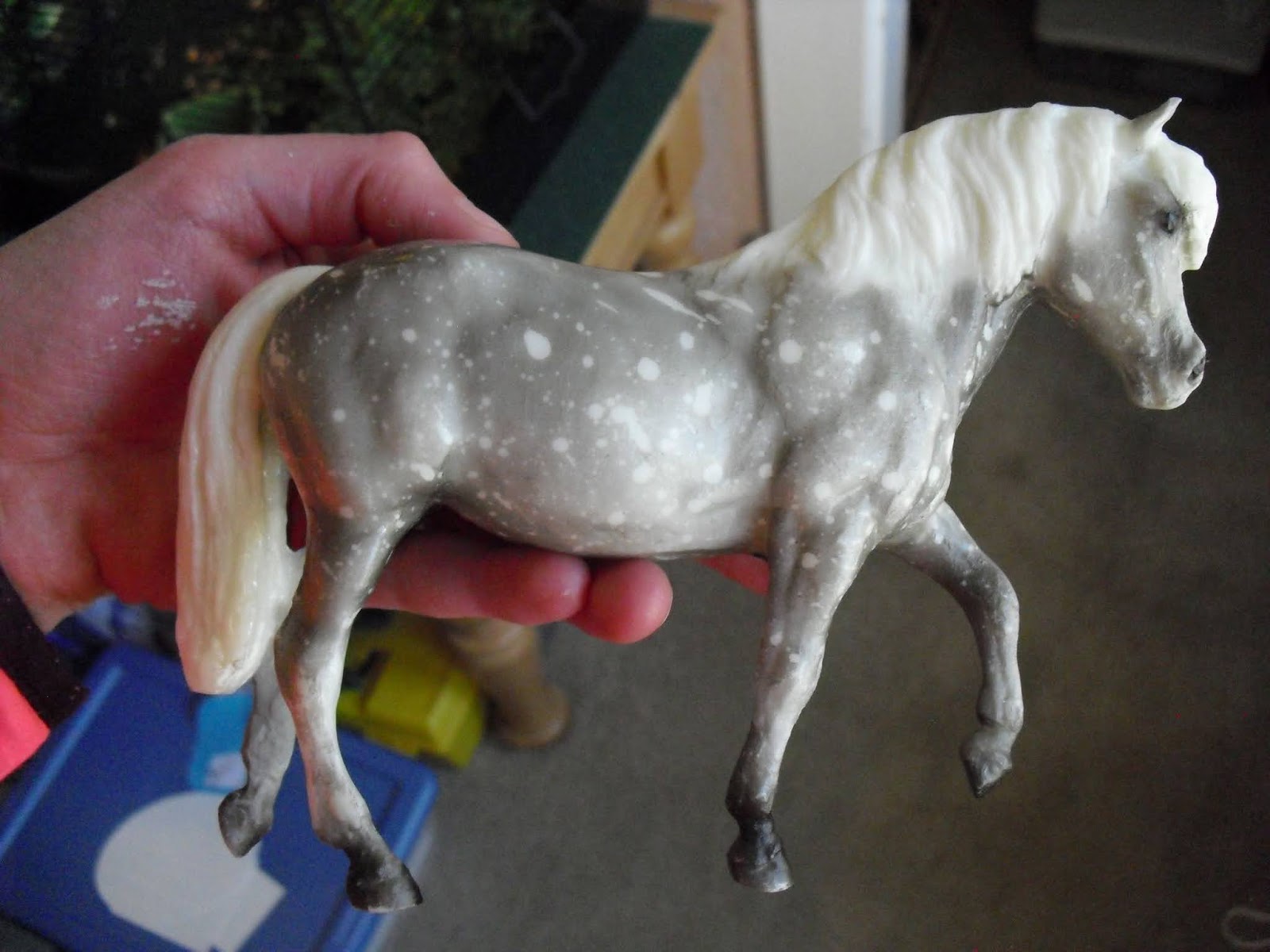
Back in May, I saw a post on Model Horse Customizers FB group of body grade model horses for sale. Of course, once I saw that there were two Shetland Ponies (plus a few others) - I knew I had to grab them as soon as possible due to their decent price. Once everyone came in the mail, I usually go onto Identify Your Breyer to see exactly who these ponies really are. And boy, was I in for a surprise! Not to mention that I felt bad for wanting to customize a vintage dappled grey model whose whites were still fairly white, but he ended up being none other than a darker variant of the original Merrylegs from the Classic Black Beauty set! Nope, not customizing this one!
But I did have to repair his hindleg. Matching colors is always stressful for me since there aren't very many guides out there for repairing model horses. My dad helped me see some of the influencing colors. The other side of his leg isn't that good, so I decided to have him only for Photo Shows.

Protective covering for spraying the matte and gloss finishes. I think he is a Glossy, so matching the sealant was another sketchy challenge.

I admit that it was probably too hot to leave these precious plastic ponies out in the sun. I checked them, and they were not harmed by the sun's burning rays. I moved them into the shade once I realized this.

 All ready for her first show! Yes, I say "her" for three reasons. One, the mold's a mare and this was a common occurrence for many of the guy Breyers of that era. Two, judges advise against labeling a mare mold a stallion or a gelding and vise versa. Unless they have a hindleg that comes far enough forward to hide the area - then label the model according to the gender of the mold. Lastly, to be honest, when I look at her face, she looks like a mare to me.


And here she is, Merrylegs the Welsh Mountain Pony coming over to get a treat!
What an awesome find!